"The appearance is thick, the grains are transparent like red pearls when peeled, and the fruit tastes sweet like honey", which is exactly what pomegranate is. Ripe pomegranates are big and red, sour and sweet, and taste very good. Pomegranates are known as the "Chinese God Fruit" and are also regarded by many friends as the "golden fruit" for autumn health preservation. So, what nutrients does it have?
"The appearance is thick, the grains are transparent like red pearls when peeled, and the fruit tastes sweet like honey", which is exactly what pomegranate is. Ripe pomegranates are big and red, sour and sweet, and taste very good. Pomegranates are known as the "Chinese God Fruit" and are also regarded by many friends as the "golden fruit" for autumn health preservation. So, what nutrients does it have?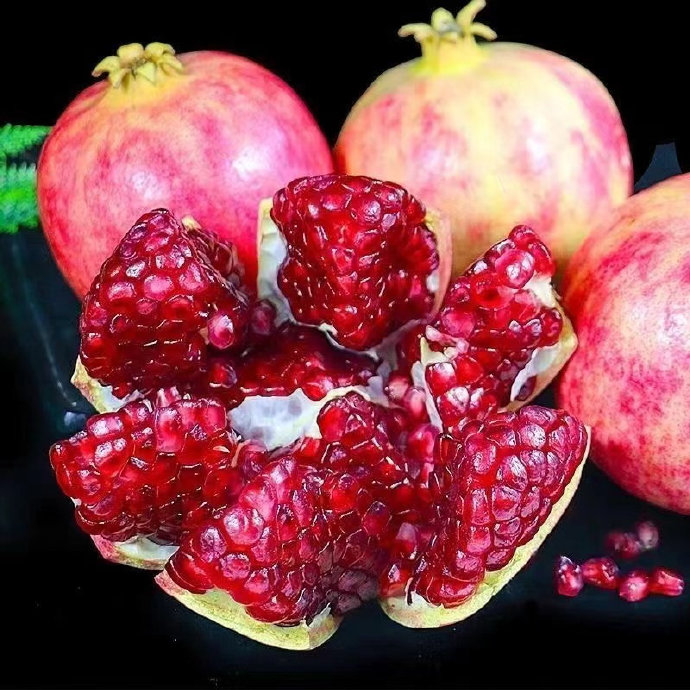
What are the nutritional values of pomegranates?
Pomegranates are native to Iran, Afghanistan and other countries along the Mediterranean coast. They were introduced to China via the Silk Road during the Han Dynasty and have a cultivation history of more than 2,000 years.
Pomegranates are rich in tannins, malic acid, amino acids, vitamins, dietary fiber and other ingredients. The protein content is twice that of apples and pears, and the calcium content is four times that of peaches. The dietary fiber contained in pomegranates is as high as 4.9g/100g, which is nearly 3 times that of apples. It can promote gastrointestinal mechanical movement, help defecation, prevent constipation, and promote intestinal health.
In addition, the potassium content of the mineral in pomegranate is 231mg/100g, which is comparable to the potassium content of banana, a potassium-supplementing fruit. Adequate potassium intake helps stabilize blood pressure, which is quite friendly for friends who need to control blood pressure.
From the perspective of traditional Chinese medicine, pomegranate enters the heart, liver, kidney, and lung meridians, and has a sour and sweet taste that produces body fluids. It has a convergent effect, which can hold the body's body fluids and reduce water loss.
The sugar content of pomegranate is 13.7%, which is quite high, a little higher than the total sugar content of bananas. Therefore, it is best for people with high blood sugar and diabetes to eat less. If you like, you can eat 100 grams each in the morning and afternoon as a snack, and pair it with a few nuts to help stabilize blood sugar.
How to choose an "excellent" pomegranate?
Look at the shape. Although the appearance of pomegranates is no different at first glance, if you look closely, we can find that some pomegranates are round in appearance, while others are slightly angular. It is recommended that you choose angular pomegranate peels, thinner flesh is sweeter! The round pomegranate has a thick skin, which makes the flesh inside difficult to mature and tastes slightly sour.
Look at the color. Pomegranates come in red, green, and yellow colors. Many people choose red pomegranates, thinking that red tastes sweeter. In fact, yellow pomegranates taste sweeter and more delicious.
Look at the crack. Choose open pomegranates, not closed ones. When buying pomegranates, pay attention to the crack at the bottom of the pomegranate. The crack of a mature pomegranate will appear like a "chrysanthemum".
Traditional Chinese medicine says that "eating too much pomegranate will help fire and produce phlegm." Pomegranates are warm in nature, and eating too much can easily cause internal heat; and pomegranates are sweet, and eating too much can easily breed phlegm and dampness, so no matter how delicious it is, you must control the amount of food you eat. Generally speaking, children should eat no more than 1/4 of a pomegranate each time, and adults should eat no more than 1 pomegranate each time, and they can be eaten 1 to 2 times a week.

