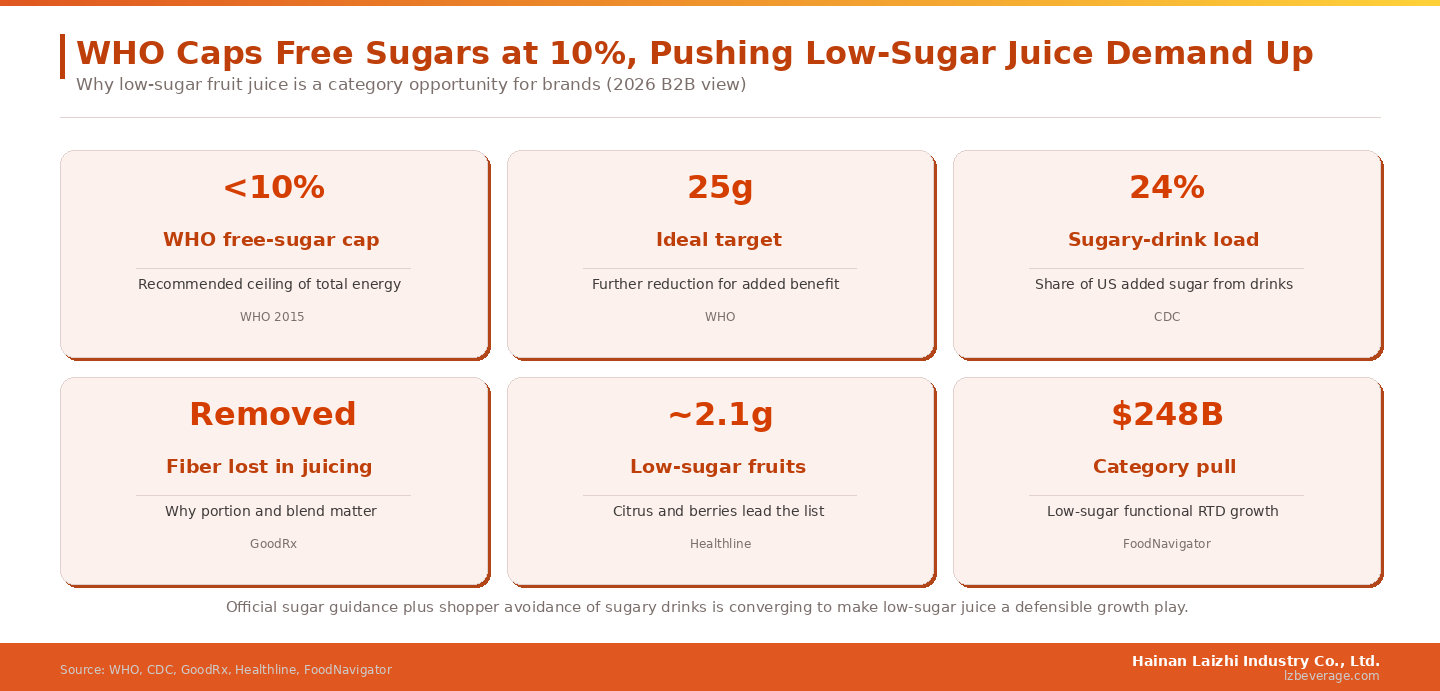
"Low sugar" is one of the strongest claims a juice brand can make right now — but it is also one of the easiest to get wrong. Health authorities are explicit: the World Health Organization recommends keeping free sugars below 10% of total energy, ideally under 5% (about 25 grams a day). Importantly, WHO counts the sugar naturally present in fruit juice as a "free sugar," which is exactly why a credible low-sugar juice requires real formulation, not just a label.
Why we wrote this: We get more "low sugar juice" briefs than almost any other, and many start from a misunderstanding — that fruit juice is automatically healthy. Because regulators treat juice sugar as free sugar, getting this category right is both a bigger opportunity and a bigger compliance risk than founders expect. This guide shows how to build a low-sugar juice that genuinely earns the claim.
Key Takeaways
- Juice sugar counts as "free sugar" to the WHO — so a low-sugar juice must be formulated, not just marketed.
- Fruit choice and blend ratio drive the sugar load; low-sugar fruits like citrus and berries work best as accents.
- The demand is real: shoppers are actively avoiding sugary drinks, opening a defensible low-sugar lane.
What "Low Sugar" Actually Means
The regulatory reality
The first thing to internalize is that fruit juice is not exempt from sugar concerns. WHO's guidance explicitly includes sugars naturally present in fruit juices and fruit-juice concentrates within its definition of free sugars. At the same time, sugary drinks are the single largest source of added sugar in many diets — the U.S. CDC attributes about 24% of Americans' added sugar intake to sugary drinks. That combination is precisely why a genuinely low-sugar juice stands out.
Why juicing changes the equation
Juicing removes most of the fiber that slows sugar absorption. As GoodRx explains, squeezing juice from fruit concentrates the natural sugar without the fiber, so it can raise blood sugar faster than whole fruit. For a brand, this means portion size, fruit selection and blend ratio matter far more than they would in whole food.
Reading the WHO definition next to the CDC's sugary-drink data reveals the strategic opening: shoppers and regulators are aligned against liquid sugar, yet most "fruit juice" still carries a high free-sugar load. A brand that formulates a genuinely low-sugar juice — and can prove the number on the label — occupies a position most competitors only claim. The honesty of the formulation is the moat.
Which Fruits Make the Best Low-Sugar Base
Fruit choice is the lever. Lower-sugar fruits work best as the flavor backbone, with sweeter fruits used sparingly. According to Healthline, citrus fruits and some berries are among the lowest in sugar — a lemon contains only about 2.1 grams. Practical low-sugar builds lean on citrus, berries and high-water fruits, using small amounts of sweeter fruit only as an accent to keep the total sugar load down.
This is where format flexibility helps: a low-sugar juice can be a still juice line, a lightly sparkling version, or a juice-water blend that dilutes sugar while keeping flavor — all viable private-label directions.
Building a Credible Low-Sugar Juice
Formulation and honest claims
The whole proposition rests on the number being real. That means choosing lower-sugar fruit bases, controlling blend ratios, and resisting the temptation to "fix" taste with added sugar. Sweetness can be balanced with acidity, careful fruit selection, or permitted natural sweeteners. A capable beverage manufacturing partner can formulate to a target sugar figure and verify it, so your label claim holds up.
Riding the category trend
The timing is good: low-sugar, functional RTD formats are leading the move toward a near-$250 billion functional market by 2030, and the broader functional category continues to be driven by demand for health-supporting ingredients. A well-formulated low-sugar juice fits squarely inside that demand.
Next-step checklist
- This week: set a target sugar number per serving (use WHO's guidance as a frame).
- This week: pick a low-sugar fruit base — citrus or berry-led.
- This month: request a low-sugar sample with a verified nutrition panel from an OEM partner.
- This month: confirm which "low sugar" or "no added sugar" claims are allowed in your market.
FAQ
Is fruit juice automatically low in sugar?
No. The WHO classifies the sugar naturally present in fruit juice as "free sugar," so many juices are high in sugar. A low-sugar juice has to be deliberately formulated to keep the figure down.
Which fruits are best for a low-sugar juice?
Citrus fruits and some berries are among the lowest in sugar and work well as the base, with sweeter fruits used only as accents to control the total sugar load.
How can a juice be lower in sugar without tasting bad?
Through fruit selection, blend ratios, acidity balancing, and permitted natural sweeteners. This article is general information, not medical or dietary advice — a flexible OEM/ODM partner can formulate to a target and verify the number. You can explore ready-to-drink formats here as a starting point for a low-sugar line.


