Starting an alcoholic beverage company is exciting — and more regulated than almost any other consumer business. Many first-time founders focus on the recipe and branding, then hit a wall: in the United States you cannot legally produce or sell alcohol until you hold the right federal permit. This guide lays out the seven steps in order, with the regulatory reality up front, so you build your launch timeline around the gate that actually controls it.
Why we wrote this: We produce beverages for brands entering markets worldwide, and the alcohol founders who struggle are almost always the ones who underestimated licensing and production lead time. This guide front-loads those two realities so you sequence your launch correctly instead of discovering the permit requirement after you've already committed to a date.
Key Takeaways
- Licensing comes before production: in the US, you need a TTB Federal Basic Permit before you can legally produce or sell.
- Federal, state and local rules stack: a federal permit is necessary but not sufficient.
- Contract/OEM production lets you launch faster than building your own facility.
The Regulatory Foundation
Why the TTB permit is step zero
In the US, the Alcohol and Tobacco Tax and Trade Bureau (TTB) is the federal authority. To operate an alcohol business you must apply for and receive a permit before operations begin, and there is no fee at the federal level to apply. Crucially, production cannot start until the permit is issued — even test batches before approval can trigger enforcement. That single fact should anchor your entire timeline.
Federal is not the whole picture
A federal permit is necessary but not sufficient. For importers and wholesalers, TTB also requires an EIN, a contract or letter of intent from a foreign supplier (for importers), and compliance with all state and local requirements, which have their own importation and wholesaling rules. You will be dealing with multiple layers of authority, not one.
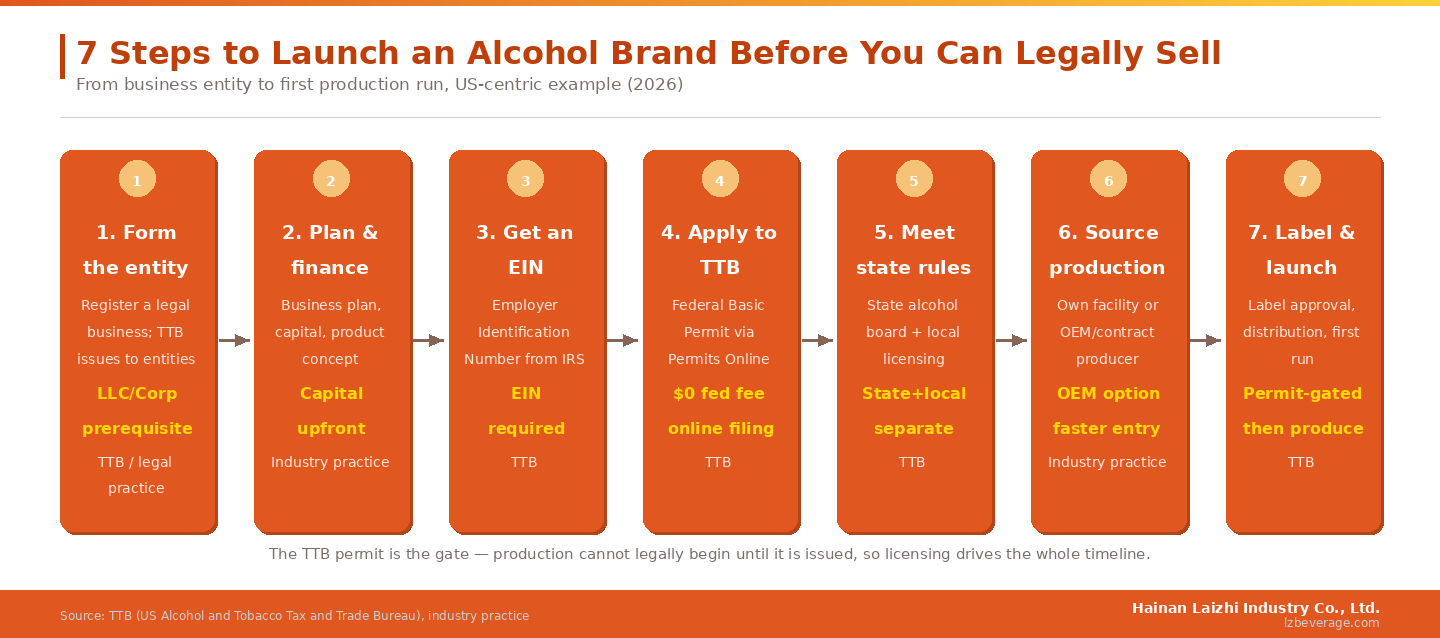
Reading the TTB qualification and permit requirements together makes the sequencing clear: the recipe and the label are not where a launch lives or dies — the permit is. Because production is legally blocked until approval, the smartest founders treat licensing as the critical path and everything else as parallel work. That reframing alone prevents the most common and most expensive scheduling mistake in this industry.
The Seven Steps in Order
With that foundation, the sequence is straightforward: (1) form a legal business entity, since TTB issues permits to qualified businesses; (2) build your business plan and secure capital; (3) obtain an EIN from the IRS; (4) apply for your TTB Federal Basic Permit via Permits Online; (5) meet state alcohol-board and local licensing requirements; (6) secure production — your own facility or a contract/OEM producer; and (7) handle label approval, distribution and your first run.
Where OEM/Contract Production Fits
Faster, lower-risk entry
Building a distillery or brewery is enormously capital-intensive. Many new alcohol brands instead start with a contract or OEM producer, which lets them validate the market before committing to fixed assets. A partner that already runs beer and other beverage lines can prototype, fill and package while you focus on branding and distribution. The same logic applies to the broader market mood: with low- and no-alcohol options surging on health-driven demand, flexible production lets you hedge across alcoholic and alcohol-free SKUs.
Don't ignore the non-alcoholic adjacency
The wider beverage market is large — the non-alcoholic segment alone is heading toward about $2.55 trillion by 2030 — and moderation and "drinking better" are now central themes. A one-stop beverage manufacturing partner can help you launch an alcohol brand and a no/low companion line from the same relationship.
Next-step checklist
- This week: register your business entity and apply for an EIN.
- This week: map your TTB permit type — producer, wholesaler, or importer.
- This month: start your TTB Permits Online application and list state requirements.
- This month: brief a contract/OEM producer to run in parallel with licensing.
FAQ
Do I need a license to start an alcohol company?
Yes. In the US you must obtain a TTB Federal Basic Permit before producing or selling alcohol, plus meet state and local requirements. Production before approval is prohibited.
How much does a TTB permit cost?
There is no fee at the federal level to apply for or maintain a TTB permit. However, you may face state filing fees, bonds, and professional-service costs depending on your operation.
Can I start without building my own facility?
Yes. Many brands use a contract or OEM producer to launch faster and with less capital. This article is general information, not legal advice — a flexible production partner and a qualified attorney can guide your specific setup. You can browse available beverage categories here to see where a contract producer can support your launch.


