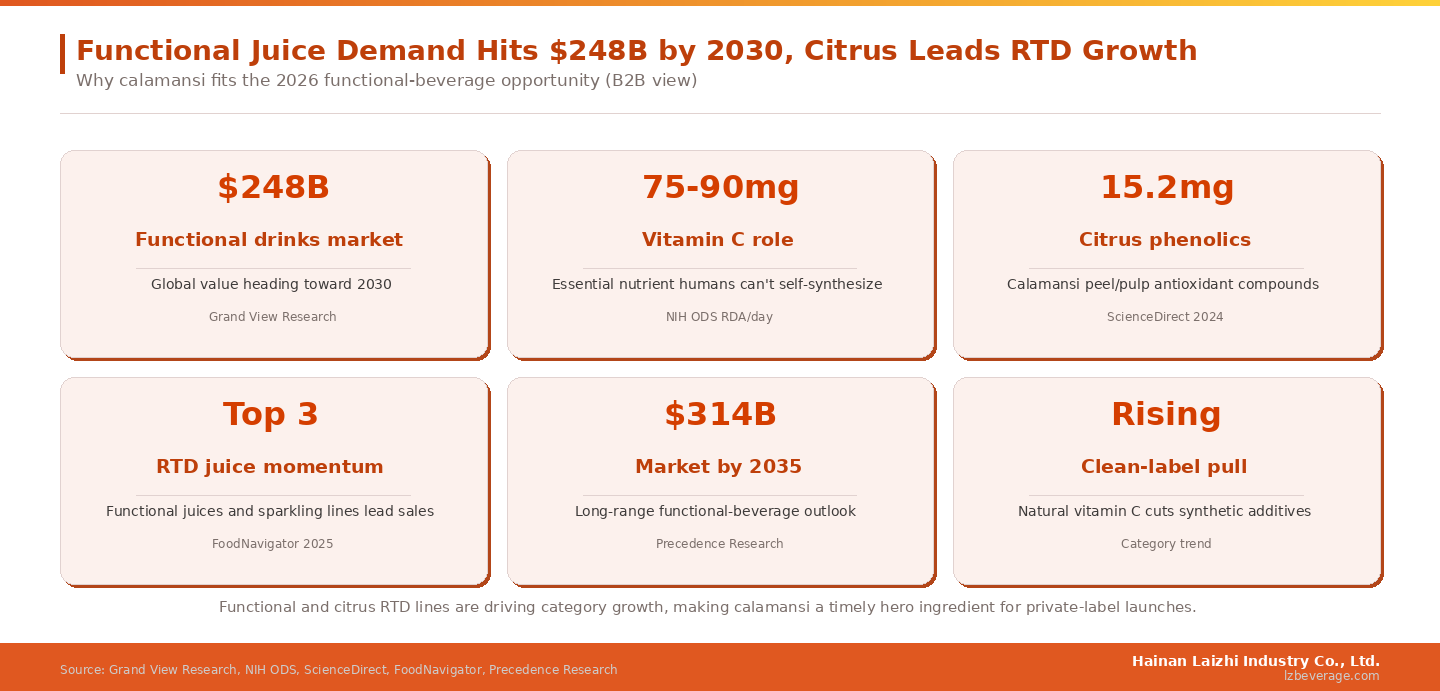
Calamansi — the small, tart citrus also known as calamondin or Philippine lime — has quietly moved from Southeast Asian kitchens to global beverage coolers. For brand owners and importers, the interesting part is timing: the global functional drinks market is on track to approach nearly $250 billion by 2030, with ready-to-drink functional juices and sparkling lines leading sales. A citrus that is naturally high in vitamin C and antioxidants fits that demand almost perfectly.
Why we wrote this: We build calamansi and other citrus drinks for export clients every week, and we keep meeting brands who love the flavor but are unsure which health claims are defensible and how to move from idea to a shelf-ready can. This guide separates the evidence-backed benefits from the marketing fluff, so you can position a calamansi product without risking a compliance problem.
Key Takeaways
- Calamansi's main asset is vitamin C plus citrus phenolics — both support immune and antioxidant claims when worded carefully.
- The category tailwind is real: functional and citrus RTD lines are among the fastest-growing beverage segments through 2030.
- The path to market is OEM/ODM: formulation, pH control, and certification matter more than the recipe itself.
What Calamansi Actually Delivers Nutritionally
Vitamin C and collagen support
The headline nutrient is vitamin C. According to the NIH Office of Dietary Supplements, humans cannot synthesize vitamin C internally, so it must come from diet, with an RDA of 75 mg for women and 90 mg for men. Vitamin C is required for collagen biosynthesis and acts as a physiological antioxidant, which is why "natural vitamin C" and "supports skin and immunity" are reasonable angles for a calamansi drink. Controlled research also shows vitamin C drives collagen formation directly: one study found it produced a dose-dependent increase in type I collagen deposits by human fibroblasts.
Citrus phenolics and antioxidant activity
Beyond vitamin C, calamansi carries flavonoids, phenolic acids, and essential oils. Analytical work on the fruit reports a total phenolic content around 15 mg GAE per gram of dry matter in calamansi extract, linked to measurable antioxidant and antimicrobial activity. For a formulator, that dual property is useful: the phytochemicals add a functional story, and the natural acidity supports product stability.
Putting the NIH vitamin C guidance next to the category data tells a clear story: brands no longer need to invent a health hook, because the nutrient profile of calamansi already maps onto what shoppers are searching for. The practical implication is that the win is execution — keeping vitamin C intact through processing and wording claims to match real nutritional data — not discovering a novel ingredient.
Why Calamansi Fits the 2026 Functional-Beverage Window
Category size is the second half of the case. The functional-beverage market is projected to climb from roughly $168 billion in 2025 to about $314 billion by 2035, while broader functional-drinks estimates point to strong single-digit CAGR growth driven by health-enhancing ingredients. Citrus-forward, lower-sugar, clean-label drinks sit right in the center of that demand.
If you are deciding where calamansi fits in a portfolio, it works as a standalone juice or RTD line, as a sparkling variant, or as a tart top-note blended with sweeter tropical fruits to balance flavor while keeping the functional positioning.
Turning the Benefits Into a Shelf-Ready Product
Formulation and quality control
The benefits only survive if processing is right. Vitamin C is heat-sensitive, so gentle pasteurization, oxygen-limiting packaging, and careful pH management protect both nutrients and shelf life. Because calamansi is naturally acidic, that same acidity helps microbial stability — but it has to be controlled, not assumed. This is where an experienced beverage manufacturing partner earns its keep, balancing taste, stability, and claim integrity in one formula.
Certification and export readiness
For export brands, documentation is as important as flavor: nutrition facts, certificates of analysis, microbial and heavy-metal testing, and correct claim wording for each destination market. Choosing a producer with HACCP and export certification in place shortens that path considerably.
Next-step checklist
- This week: list the 2-3 health claims you want and check each against NIH vitamin C data.
- This week: decide format — still juice, sparkling, or tropical blend.
- This month: request a calamansi sample and spec sheet from an OEM partner.
- This month: confirm certification and labeling needs for your target export market.
FAQ
Is calamansi juice good for skin?
It can support skin indirectly. The link is vitamin C, which is required for collagen synthesis and acts as an antioxidant; calamansi is a natural source. Claims should reference the nutrient, not promise cosmetic outcomes.
Can calamansi be made into a low-sugar drink?
Yes. Its tart, bright flavor carries well with little added sugar, which makes it a natural fit for the low-sugar and "better-for-you" beverage trend.
What is the minimum to launch a private-label calamansi drink?
That depends on the manufacturer's MOQ and your format. A flexible OEM/ODM partner can advise on minimum order quantity, sampling, and lead times for your specific can or bottle. If you are scoping a citrus or tropical line, you can explore ready-to-drink formats here as a starting point.


