"What type of drink should we launch?" is one of the first questions any new beverage brand has to answer — and most online lists answer it by simply naming drinks. That misses what actually matters: how beverage categories are defined, why those definitions affect taxes, labeling and shelf placement, and which categories are growing. The non-alcoholic beverages market alone is projected to reach about $2.55 trillion by 2030 at roughly 8% CAGR, so picking the right lane is a real strategic decision.
Why we wrote this: We help brands choose a category and then build it, so we see how often a "small" classification choice — soda vs. flavored water, juice vs. nectar — changes cost, claims and compliance. This guide organizes the beverage world the way a manufacturer thinks about it, not just as a flavor list, so your first decision is grounded.
Key Takeaways
- Beverages split first into alcoholic and non-alcoholic, then into well-defined sub-categories with real regulatory meaning.
- Definitions matter commercially: "juice" vs. "nectar" or "soda" vs. "flavored water" affect labeling, claims and taxes.
- Functional and RTD formats are the fastest-growing entry points for new private-label brands.
How Beverages Are Actually Classified
The two top-level branches
At the highest level, beverages divide into alcoholic and non-alcoholic. Within non-alcoholic, official frameworks give useful structure: the Codex Alimentarius classifies them into waters and carbonated waters, fruit and vegetable juices and nectars, flavored carbonated/non-carbonated drinks, and brewed beverages such as coffee and tea. That same source notes carbonated soft drinks, RTD tea/coffee, energy and sports drinks together account for more than 60% of the global non-alcoholic market.
Why a definition is a business decision
These labels are not academic. A "100% fruit juice" carries different claim and labeling rules from a "nectar" (25-99% juice) or a flavored water. On the alcoholic side, ready-to-drink products are split by base — malt-based, spirits-based and wine-based RTDs — and that base determines tax rate, store placement and licensing. RTD cocktails themselves are defined as flavored alcohol beverages that are sweet or carbonated, often containing multiple servings per can — a detail with labeling and responsibility implications.
Putting the Codex framework next to the RTD base-classification rules shows the real lesson: the category you pick is upstream of almost every later cost. Two products with identical taste can face completely different tax, claim and distribution paths purely because one is filed as a soda and the other as a flavored water, or one RTD is malt-based and another spirits-based. For a new brand, that means classification belongs in the first planning conversation, not the last.
The Main Beverage Families at a Glance
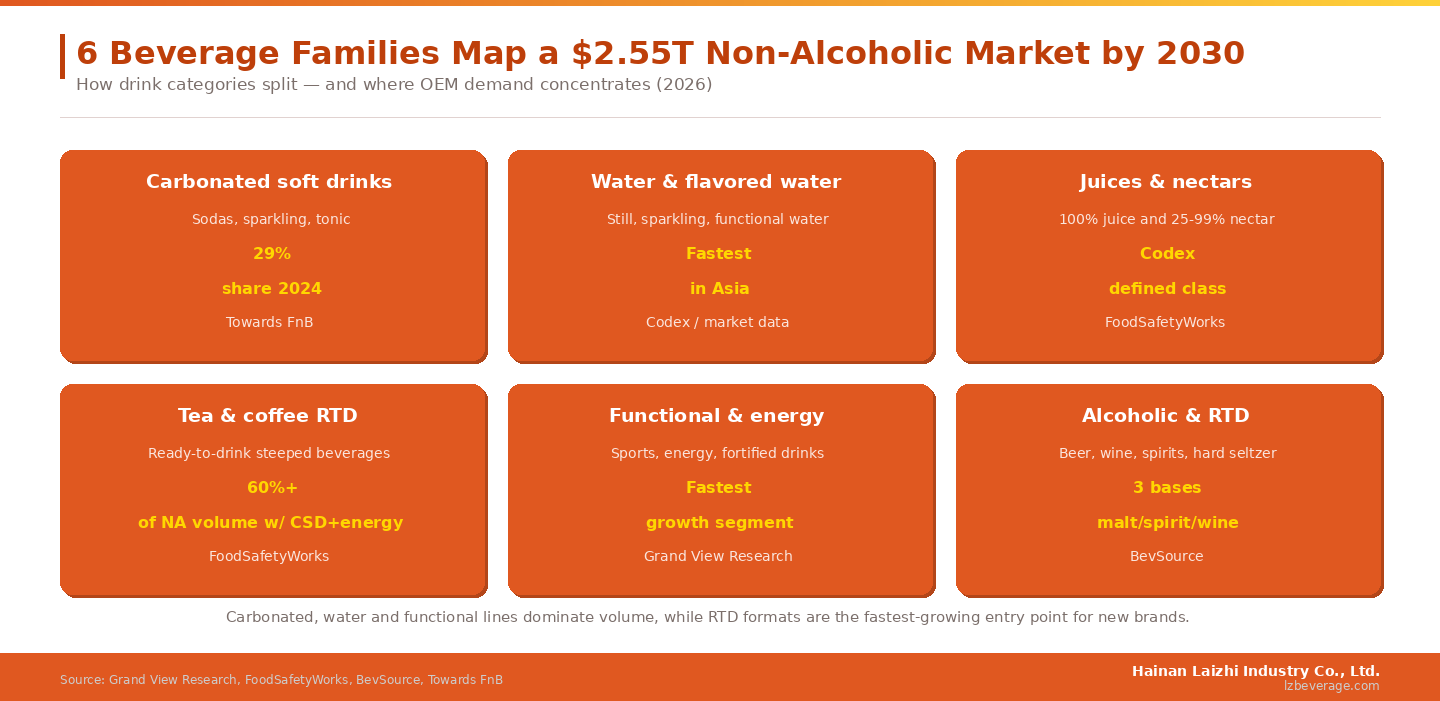
For practical purposes, most drink brands operate within a handful of families: carbonated soft drinks; bottled and flavored water; juices and nectars; RTD tea and coffee; functional and energy drinks; and alcoholic products including beer and RTDs. Functional beverages are the standout — growth is being driven by demand for drinks enriched with health-supporting ingredients, and RTD functional formats are leading the move toward a near-$250 billion functional market by 2030.
Matching a Category to Your Brand
Where new brands usually start
Carbonated and water categories offer scale but intense competition; functional and RTD categories offer differentiation and margin. In practice, many of our partners enter through a focused line — an energy drink, a tea beverage, or a juice — rather than trying to span everything at once. You can see the full range of categories on the product overview to map where your idea fits.
The OEM/ODM angle
Each category brings its own production reality: carbonation control for sodas, pH and preservation for juices, caffeine and fortification for energy drinks, and brewing or alcohol handling for beer and RTDs. A one-stop beverage manufacturing partner that already runs multiple lines can prototype across categories before you commit, which lowers the risk of choosing the wrong lane.
Next-step checklist
- 1. This week: pick one primary category from the six families above.
- 2. This week: confirm whether your concept is a juice, nectar, or flavored drink.
- 3. This month: check tax, labeling and placement rules for that category in your market.
- 4. This month: request samples in your chosen category from an OEM partner.
FAQ
What are the main types of beverages?
They divide first into alcoholic and non-alcoholic. Non-alcoholic includes water, juices and nectars, carbonated soft drinks, RTD tea and coffee, and functional/energy drinks; alcoholic includes beer, wine, spirits and RTDs.
What is the difference between juice and nectar?
It is mainly juice content. "100% fruit juice" is fully juice, while a nectar typically contains 25-99% juice with added water or sweeteners — and the two are labeled differently.
Which beverage category is best to start a brand in?
There is no single answer, but functional and RTD formats currently offer the strongest growth and differentiation. A flexible OEM/ODM partner can prototype across categories so you can choose based on data, not guesswork.


